

You shouldn't have to choose between a 45-minute barn commute and settling for inadequate turnout. The right property gives you both, space for your horses and reasonable access to Charlotte's amenities, veterinary specialists, and employment opportunities.
Huntersville has quietly become one of the Charlotte Metro area's most practical solutions for equestrians who refuse to compromise on either proximity or property quality.
Why Huntersville's Location Solves the Proximity Problem
Huntersville sits 14 miles north of Charlotte's center, positioned along I-77 with direct access to the city while maintaining genuine rural character in its northern and western sections. This isn't suburban horse-keeping with neighborhood complaints about manure piles. Properties here offer legitimate acreage with the infrastructure horses actually need.
The Lake Norman corridor provides a buffer, development concentrated near the water leaves the interior areas available for agricultural use. You'll find properties ranging from 10 to 98 acres, with the larger parcels often bordering protected land or state parks that ensure your pastoral views remain intact.
Morning feed can happen at 6 AM, and you can still make an 8:30 AM meeting uptown. Evening rides don't require negotiating rush hour for an hour each direction.
Current Market Reality: What's Available and What It Costs
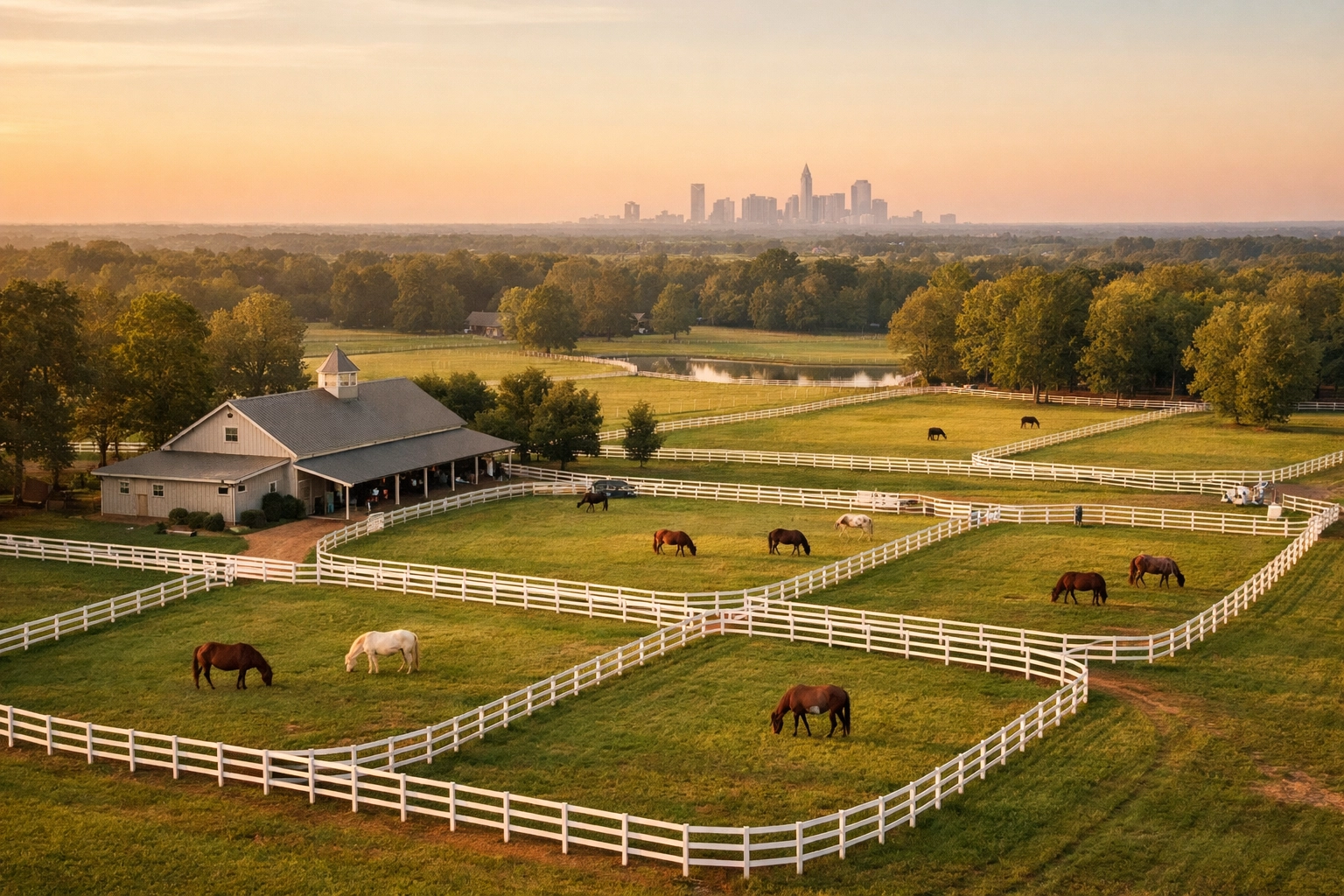
As of early 2026, Huntersville maintains an active inventory of 8-12 equestrian properties at any given time. This isn't Tryon with its concentrated horse community, but it's enough selection to be viable without the feeding frenzy of more limited markets.
Pricing spans from approximately $389,500 to $2,350,000, reflecting the range from starter farms to established estates. Land costs average $76,000 to $236,000 per acre depending on improvements, location within Huntersville, and existing facilities.
Current listings include options like a 10-acre setup with a 9-stall barn, suitable for a small breeding operation or training facility, and a 98-acre estate that borders South Mountain State Park with extensive trail access. The variety means you're not forced into a property that's either too small for your program or unnecessarily large for your needs.
The market here moves at a measured pace. Properties stay listed long enough for proper due diligence, soil testing, facility inspections, zoning verification, without the pressure of same-day decisions common in hotter markets.
What Separates Adequate Properties from Actual Horse Farms
Not every property with a barn and fence qualifies as functional equestrian real estate. Horse people know the difference immediately.
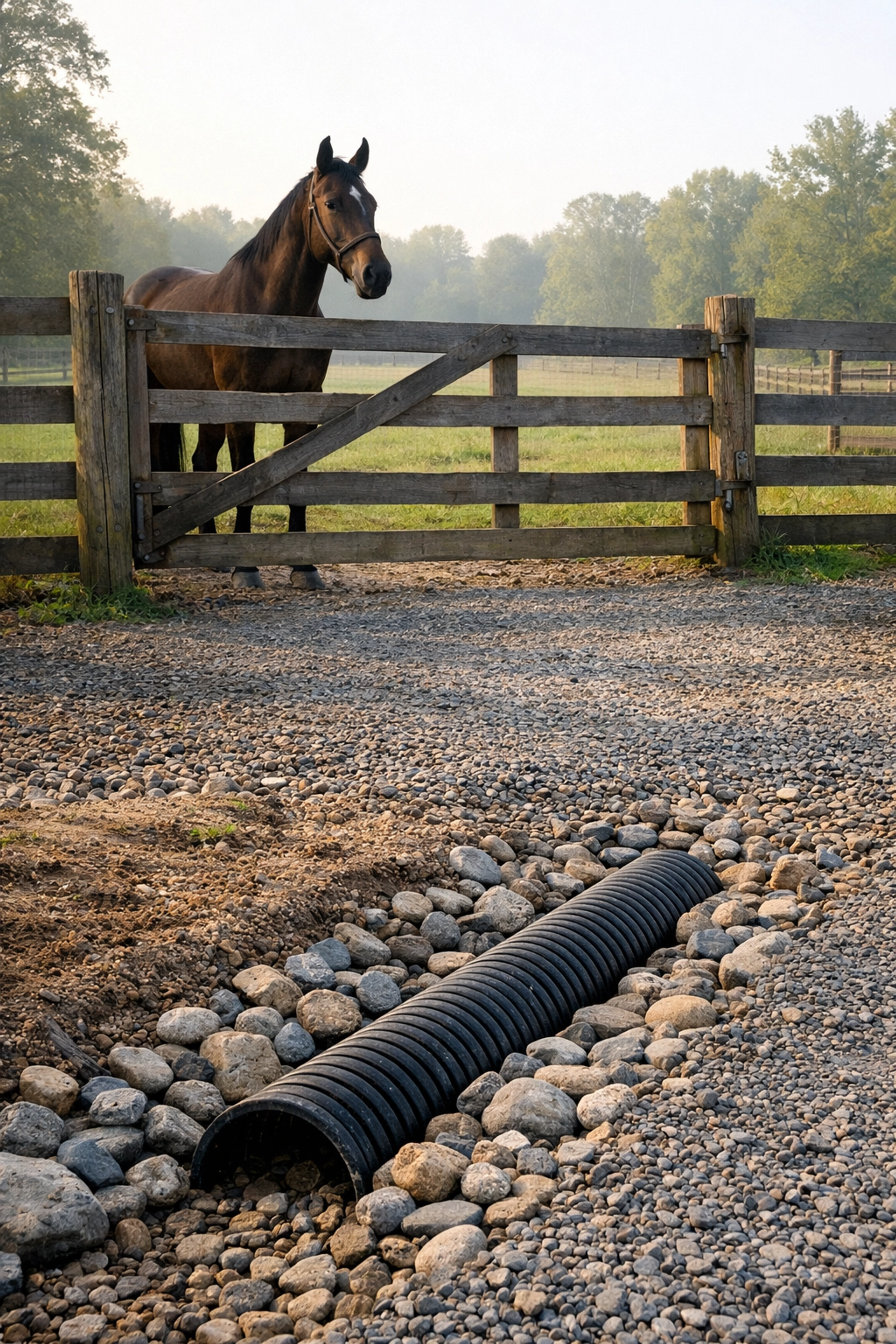
Drainage and topography matter first. North Carolina receives 43 inches of annual rainfall. Properties with poorly planned paddocks become mud lots from November through March. Look for natural slope, French drains near high-traffic areas, and sacrifice lots that can handle winter turnout without destroying your pastures.
Pasture quality indicates management history. Drive the property and identify the grasses. Fescue-dominant pastures require supplemental hay and careful grazing rotation. A mix that includes orchard grass, timothy, or clover suggests previous owners understood forage management. Bare spots, erosion channels, and weed overgrowth tell you exactly how much work awaits.
Barn layout reveals whether previous owners actually kept horses or just liked the aesthetic. Stalls should be 12×12 minimum, with dutch doors or top openings for ventilation. Tack rooms placed between barn sections rather than tacked onto the end show thoughtful design. Hay storage separated from the main barn reduces fire risk. Wash racks with proper drainage, hot water access, and cross-ties mean someone planned for actual horse care, not just photo opportunities.
Fencing type and condition matter more than cosmetic property appeal. Board fencing looks elegant but requires constant maintenance and replacement. Well-installed flex fence or coated wire provides safety and longevity. Check corner bracing, gate functionality, and whether fence lines follow safe contours rather than creating dangerous angles.
The Commute Calculation: Charlotte Access Without the Daily Grind
Huntersville's position along I-77 provides direct southern access to Charlotte, but the real advantage shows in the road network for equestrian necessities.
Veterinary access: Multiple equine veterinary practices serve the Lake Norman area, with emergency clinics reachable within 20-30 minutes. NC State's College of Veterinary Medicine in Raleigh sits two hours east, far enough to be inconvenient, close enough to be accessible for specialty referrals.
Feed and supply runs: Southern States and Tractor Supply locations throughout northern Mecklenburg County mean you're not driving 40 minutes for quality hay or emergency supplies. Local feed mills deliver to the area regularly.
Trainer and farrier logistics: The concentration of equestrian properties in Union County and southern Mecklenburg means many professionals already include Huntersville in their regular routes. You're not the isolated client requiring special trip charges.
Show and event access: Venues like the Carolina Horse Park (1.5 hours), Tryon International (1.75 hours), and the Virginia Horse Center (4 hours) remain accessible for weekend competitions without requiring overnight stays for closer shows.
The commute only works, however, if you're realistic about your schedule. Working from home several days weekly makes Huntersville feasible. A five-day office schedule with unpredictable late hours presents complications unless you have staff or cooperative barn partners.
How to Actually Find These Properties
Generic real estate searches miss the nuanced details that separate horse-friendly properties from actual equestrian facilities.
Start with specialist platforms. HorseProperties.net filters specifically for equestrian amenities in Mecklenburg County, eliminating properties that merely have "land" but lack proper infrastructure. Realtor.com's horse stable filter currently shows limited inventory, two properties, but updates regularly as new listings arrive.
Work with agents who understand horse property requirements. A residential agent may show you a beautiful property with a picturesque barn that lacks adequate water pressure for barn use, insufficient electric service for heated water buckets, or property lines that create landlocked pastures. Equestrian specialists recognize these issues immediately and eliminate properties that won't function for your program.
Drive the area before scheduling showings. Huntersville's equestrian properties cluster in specific pockets. Understanding which areas provide the rural character you want versus which have encroaching development helps narrow your search efficiently. Northern and western sections of Huntersville generally offer more agricultural zoning and larger parcels.
The Zoning and Regulation Consideration
Mecklenburg County zoning regulations permit horses but include specific requirements that affect property functionality.
Most equestrian properties fall under RA (Rural Area) or R-40 (Residential, 40,000 sq ft minimum lot) zoning. These classifications generally allow horses by right, but confirm the specific parcel's zoning before writing an offer. Some transitional properties near residential development may have restrictions or require special use permits.
County regulations typically require one acre per horse for the first two horses, then one acre per two additional horses, less stringent than some areas but still requiring adequate space for proper turnout and pasture rotation.
Manure management regulations exist but remain reasonable. You'll need a plan for proper storage and disposal, but small operations can typically handle this through composting and field application. Larger facilities may require contracted removal services.
Well water is common in rural Huntersville. Budget for water testing and potential treatment systems. Verify well capacity can handle both household and barn use: inadequate water pressure becomes expensive to remedy after closing.
Making Huntersville Work: The Practical Reality
Huntersville equestrian properties offer a genuine middle ground for horse owners who need city proximity without sacrificing proper facilities. This isn't the idyllic isolation of Tryon or the concentrated horse community of Weddington, but it provides functional solutions for specific situations.
You'll still drive to UPS stores and specialty shopping. Your neighbors may include residential development a half-mile away rather than nothing but farms. Internet service can be inconsistent in some areas: critical if you work remotely.
What you gain is measurable: 30-minute vet response time instead of 90 minutes, reasonable commutes to Charlotte employment, and properties large enough for proper horse management without the premium pricing of closer-in areas.
The properties exist. The infrastructure functions. The location provides access without forcing compromise on space or facilities. For horse owners who've spent years convinced they needed to choose between their career and their horses, Huntersville presents a third option worth serious consideration.
If you're ready to explore what's currently available or want guidance on which sections of Huntersville match your specific equestrian program needs, reach out to our team. We work with horse people looking for properties that actually function( not just properties with a barn in the photos.)

